Arizona's argument over Empowerment Scholarship Accounts keeps collapsing into one word: defunding. It is a good word for a flyer. It is a bad word for a budget.
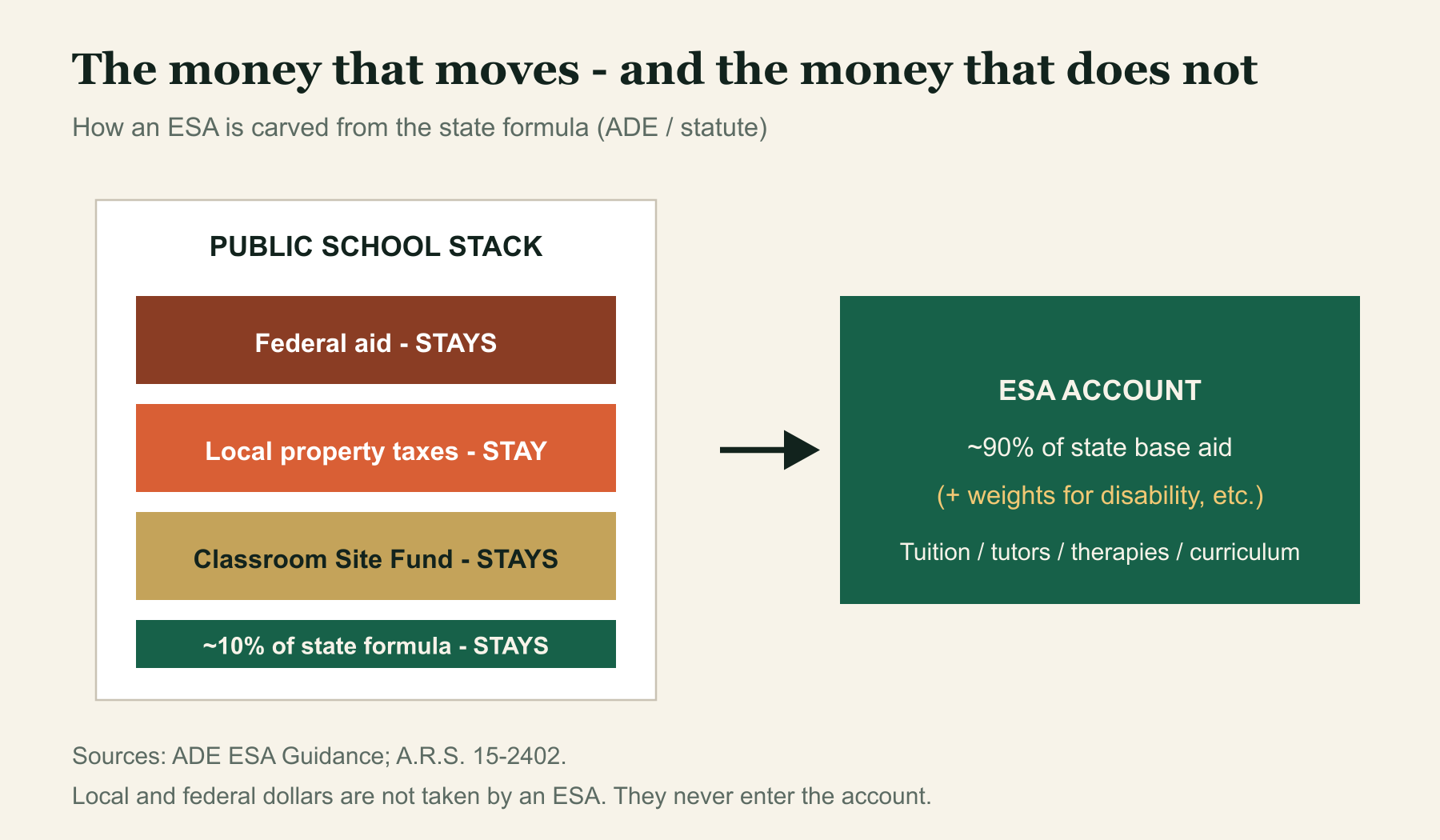
An ESA does not take a district's property taxes. It does not take federal Title money. It does not take Classroom Site Fund dollars. Under ADE rules and A.R.S. § 15-2402, the account is about 90 percent of the state formula aid that would have followed that student to a district or charter — and only after the student leaves. Local and federal dollars never enter the account. ESA students also get $0 from the Classroom Site Fund, roughly $1,000 per public-school pupil that stays put.
If "defunding" means the public pile got smaller after universal expansion, the JLBC tables do not cooperate. In FY 2022, the year HB 2853 opened ESAs to every K-12 student, state and local K-12 funding was about $11.8 billion, or $10,657 per student. By FY 2024 it was $14.0 billion and $12,726. JLBC's FY 2026 estimate is $14.4 billion and $13,325. That is roughly $2.6 billion more in state and local money while ESA enrollment climbed past the old niche program and into six figures.
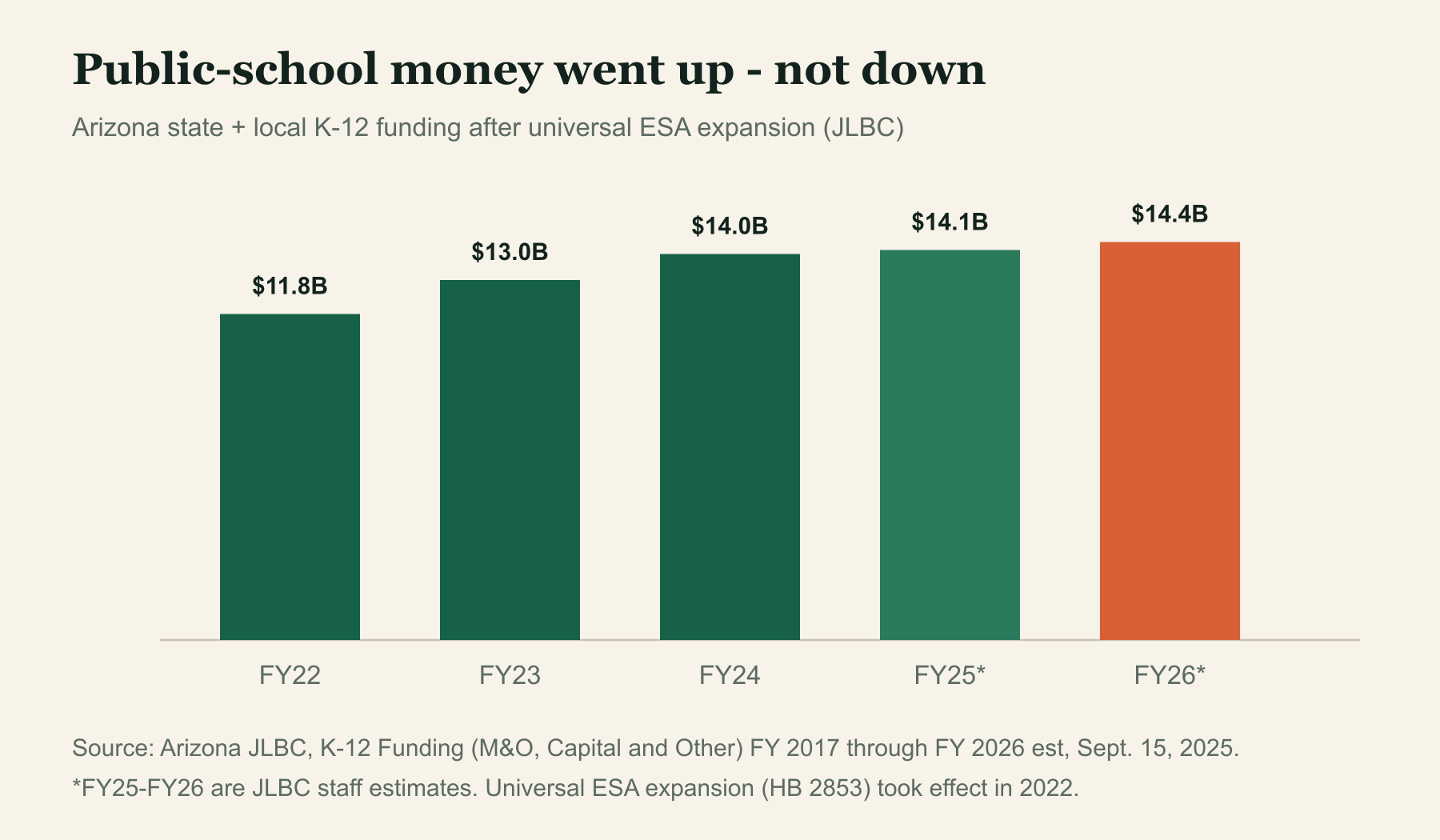
After inflation, the same JLBC series still points up: state-and-local funding per student moves from $9,843 in FY 2022 to $10,358 in the FY 2026 estimate — more than $500 higher. You can dislike ESAs and still have to explain why a rising appropriation counts as a raid.
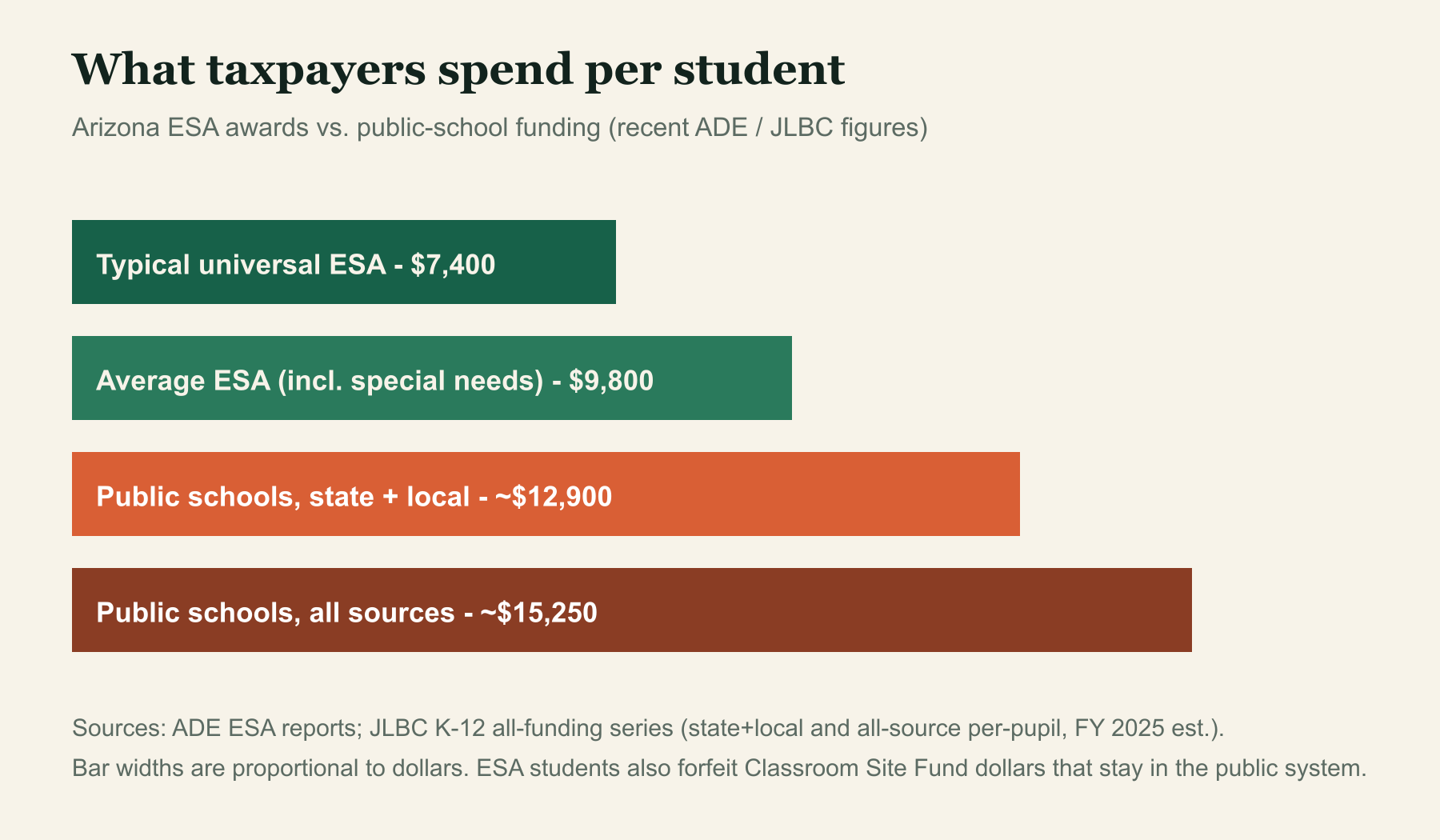
The cost-per-kid math is worse for the bankruptcy claim. ADE reporting puts a typical universal ESA near $7,400. The average award, lifted by a higher share of students with disabilities, is about $9,800. JLBC's FY 2025 all-source public-school figure is about $15,250 per student; state-and-local alone is near $12,900. A scholarship that costs less than the fully loaded public seat is an odd definition of looting the schools.