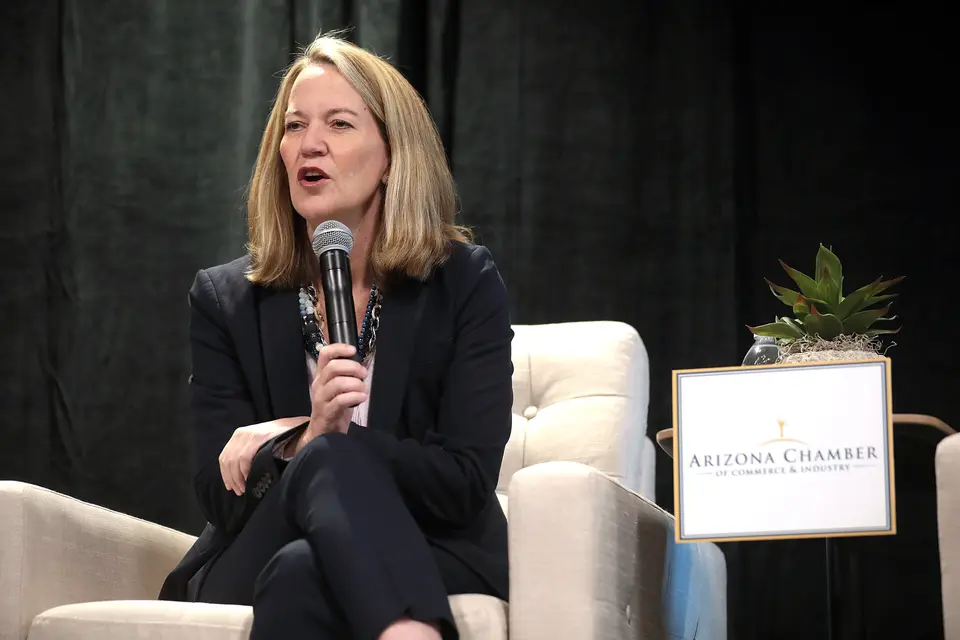
Arizona Attorney General Kris Mayes is not committing to defend Proposition 314 on the merits, telling reporters she is taking a wait-and-see approach while lawsuits over the voter-approved border measure move ahead. At the same time, she pointed out that her office already convinced a federal judge not to temporarily block the law while litigation proceeds.
U.S. District Judge Michael Liburdi has not ruled on whether Prop. 314 runs afoul of a 2012 U.S. Supreme Court decision that struck down key parts of SB 1070. That leaves the measure’s fate unsettled and keeps Mayes’ role unsettled too. She said her job is to defend state laws when she believes there is a good-faith, constitutional argument to uphold the will of voters, but added, “we haven’t gotten there yet.”
For police chiefs, sheriffs, and border communities, that limbo translates into operational questions and budget worries. Mayes opposed Prop. 314 as an unfunded mandate and said sheriffs and local law enforcement told her they do not have the money to carry it out. She also warned the measure could lead to racial profiling. Voters nevertheless approved Prop. 314 by nearly a 2-to-1 margin in 2024, setting up a collision between local capacity and a strong statewide directive for tougher enforcement.
Prop. 314 does more than authorize arrests for illegal entry between ports of entry. It creates a state crime for submitting false information to get a job or government benefits and increases penalties when fentanyl imported from another country causes a death. Its most controversial piece lets state and local officers arrest noncitizens who enter anywhere other than a port. The offense is a misdemeanor. Judges may dismiss the charge if the defendant agrees to return to the border for removal. A delayed effective scheme tied the law’s start to the resolution of litigation over a similar Texas statute, a trigger that occurred July 14.
The Florence Immigrant & Refugee Rights Project sued last month, arguing Prop. 314 intrudes on federal immigration powers. The case leans on the Supreme Court’s SB 1070 ruling, which invalidated provisions making it a state crime for undocumented immigrants to seek work and requiring immigrants to carry federal registration documents. Judge Liburdi declined to block enforcement, finding the Florence Project lacked standing and noting no one has yet been arrested under the law. He reserved judgment on the constitutionality, with further proceedings set for next week.
Mayes has a track record of declining to defend statutes she believes are unconstitutional. She refused to defend Arizona’s 1864 near-total abortion ban, a 24-hour abortion waiting period, and a Maricopa County case over whether lawmakers can bar some advanced practice nurses from performing abortions. She also would not defend a 2022 law restricting transgender girls, defined as students born biologically male, from participating in girls’ sports. State schools chief Tom Horne took up that defense, and challengers ultimately dismissed the case.